
 Best Christian Workplaces
The $2 Trillion Problem Every Christian Executive Must Address
 Robert Wachter : October, 06 2025
Address disengagement and turnover in Christian-led businesses by cultivating a thriving culture, ensuring employee engagement, and boosting...

Culture work compounds over time. Hundreds of faithful leadership decisions (many of which seem invisible in the moment) shape a healthy workplace. Northwestern College’s journey reminds us of what can happen when leaders deliberately invest in people and culture year after year.
Founded in Orange City, Iowa, in 1882, Northwestern College exists to “engage students in courageous and faithful learning and living that empowers them to follow Christ and pursue God’s redeeming work in the world.”
As president, Greg Christy believed those words weren’t only meant for students. They were for anyone who walked Northwestern’s halls. If the college hoped to form courageous and faithful graduates, it first needed a workplace where leaders, faculty, and staff modeled those same values. That conviction led Greg and his leadership team to begin measuring and strengthening Northwestern’s workplace culture.
Twelve years of unwavering commitment from President Christy and his team have helped Northwestern College become one of the healthiest Christian higher education institutions measured by Best Christian Workplaces’ Employee Engagement Survey.
In 2025, Northwestern earned an overall employee engagement score of 4.19 (on a 5-point scale). This is an exceptional achievement in Christian higher education, where the complexities of leadership include serving faculty, students, and donors; navigating accrediting bodies; and remaining faithful to theological convictions in an ever-changing world.
Although Northwestern’s culture is healthy now, its story did not begin there.
In 2014, Northwestern College faced a challenge beyond its commitment to mission. President Christy knew his people believed in the college’s work and why they existed. The problem he and his team were up against was much deeper.
“We don’t have a mission problem,” Greg realized. “We have a culture problem.” That realization changed everything.
Northwestern had gaps in trust between leaders and employees; staff doubted that executives had the answers to survive in the competitive higher education world, and they didn’t believe their voices were going to be heard. Greg and his team needed a clearer way to understand those challenges before they could begin addressing them.
Greg first learned about Best Christian Workplaces through Northwestern’s connection with the Global Leadership Summit. The message he heard was simple but challenging: if you want a healthy culture, you must be willing to measure it.
Greg and his team chose to act. They partnered with Best Christian Workplaces to implement the Employee Engagement Survey, followed by discovery groups. The process confirmed what Greg suspected: the college had a culture problem that wouldn’t resolve itself. Rather than becoming discouraged, Greg saw the results as a clear diagnosis. Their baseline engagement score of 3.65 became the catalyst for several decisions that would reshape the institution.
During the next two academic years, Greg made a change in the provost role, brought in an interim provost for one year from outside Northwestern, changed the leadership and structure in admissions, reimagined the college’s approach to Christian formation, and at the end of the calendar year made additional changes in the leadership of its football and nursing programs.
These decisions weren’t easy. Despite the upheaval, Northwestern surveyed again in 2015. Their score declined, from 3.65 to 3.50.
Looking back, Greg now sees that season as a turning point. Although the changes disrupted the organization in the short term, they laid the foundation for a stronger leadership team and affirmed that a vibrant culture was essential for Northwestern to more fully live out its mission.
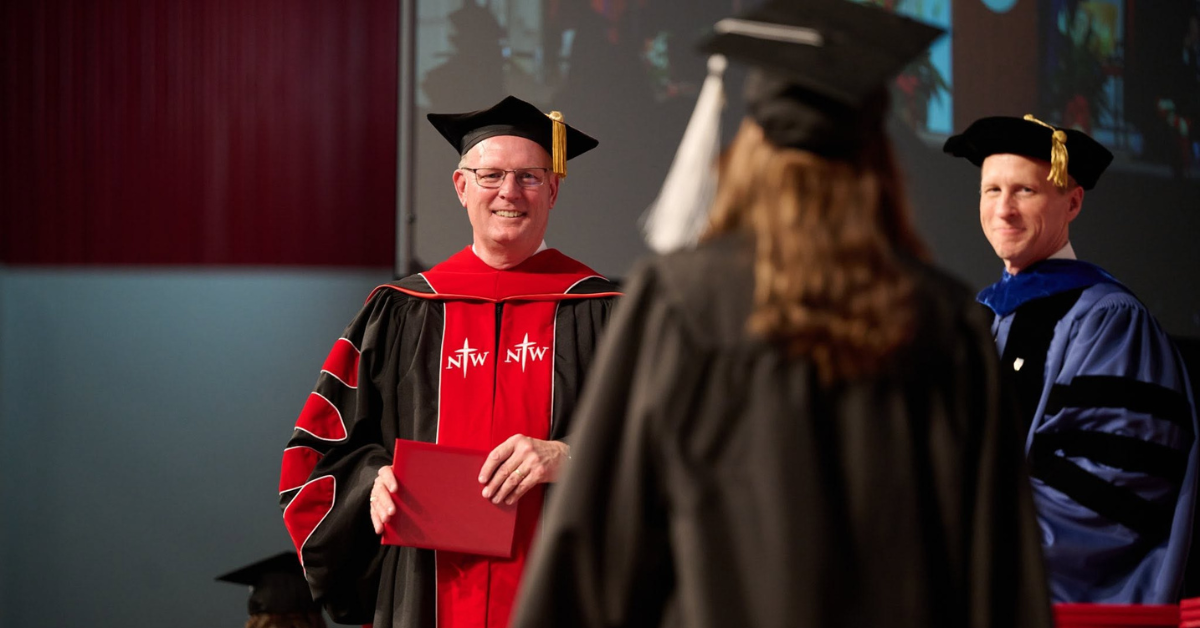
Culture transformation proved slower than many expected. Each year, Greg and his cabinet reviewed survey results, identified priorities, communicated what they had learned, and implemented changes before measuring again.
Progress came incrementally, and there were moments the team wanted to take a year off. Some cabinet members understandably wondered, “Should we just take a break? Maybe we’re raising people’s expectations simply by surveying.”
By 2021, eight years after their first survey, Northwestern College reached a score of 3.89, nearly 0.40 points above their lowest engagement score and near Best Christian Workplaces’ higher education sector average. But Greg refused to lower the standard. Healthy wasn’t to be measured on a curve.
President Christy resolved, "We want to make this a better place to work every year."
Cary Humphries, Senior Consultant at Best Christian Workplaces, who works alongside President Christy and his team, believes Northwestern’s greatest strength is not a single initiative. Instead, it’s their consistency.
“Commit to culture even when it’s hard. Greg had complete resolve to build Northwestern’s culture and decided, ‘I’m going to listen to my staff every year.’ The results won’t always be encouraging, but they will always be helpful and actionable. Your resolve to keep asking signals your trust in your team,” Cary says.
Greg believes the leadership transitions he made early in their culture journey were among the most significant decisions of his tenure at Northwestern. While challenging in the moment, they created the opportunity to build a leadership team united around Northwestern’s mission and committed to cultivating a healthy workplace.
"Every person we hire is going to help us further that mission... or detract from that mission," he says.
Leadership changes are rarely comfortable, especially in Christian-led organizations where relationships matter deeply. But Greg believed that caring for the institution’s health sometimes required making difficult decisions. Each time a position opened, demonstrated culture fit became an essential search criterion.
Northwestern’s leadership team now shares an unwavering commitment to the College’s mission and vision and believes a healthy culture requires intentional leadership. Together they’ve strengthened alignment, increased accountability, and built a shared ownership of culture. The team continues to listen to faculty and staff annually.
Northwestern’s culture has changed in ways that extend far beyond survey scores. Faculty and staff experience greater trust in leadership, stronger communication, and increased confidence that their feedback matters. Those changes create a healthier environment for the people who serve Northwestern's students every day.
Greg admits, “We don't get it right every day,” but he and his team dare to keep investing in their people.
Today, Northwestern’s employee engagement score of 4.19 is not viewed as the finish line. It has become a new starting point. The leadership team continues to listen, learn, and pursue ways to make Northwestern an even healthier place to work.
President Greg Christy: “We have a noble mission at Northwestern, but it is our people who make our mission come alive. We must prioritize culture. To do what our founders envisioned is only possible with a healthy culture. We are honored to be the stewards of mission and culture.”
Northwestern’s transformation began with the courage to face reality, continued through difficult leadership decisions, and has been sustained through a decade of faithful listening and improvement. That kind of leadership requires the courage to:
Northwestern’s journey demonstrates that a healthy culture is rarely the result of one dramatic initiative. Healthy culture is built when leaders faithfully steward the people God has entrusted to them by continuing to listen, act, and invest.
And it won’t surprise you to hear Greg say he’s enjoying his work more. Greg shares, “Leadership in Christian higher education is a privilege and a tremendous responsibility. The culture we have built at Northwestern is counter-cultural in this moment. I truly believe our standout culture is one of the keys to Northwestern experiencing our largest undergraduate enrollment growth in a decade and two years in a row of record giving to the College. Enrollment growth and financial support are byproducts of faithfully living out one’s mission and building a culture that stands out in today’s world. What a joy to serve with the dedicated faculty, staff, and administrators of this incredible place.”
Resources
To learn more about trends in Christian higher education and other Christian-led workplaces, explore the State of the Christian Workplace 2026.
5 Essentials for Building God’s Kingdom Through Higher Education: Listen to the podcast conversation between President Greg Christy of Northwestern College and Al Lopus, Co-founder and Board Chair of Best Christian Workplaces.
Northwestern’s culture journey began with a willingness to measure what employees were actually experiencing. The Employee Engagement Survey can help you gain that same clarity about your workplace — and turn honest feedback into actionable insight.
 Robert Wachter : October, 06 2025
Address disengagement and turnover in Christian-led businesses by cultivating a thriving culture, ensuring employee engagement, and boosting...
 Robert Wachter : August, 14 2023
Pastors and leaders often imagine the healthy, functioning, flourishing teams they long for, but simply don’t know what steps could help them get...

 Faith Gaines : September, 28 2026
Learn how Christian leaders can rebuild organizational trust after change by listening well, involving employees, and creating a clear path forward.