Your organization has made it through a difficult season. The immediate crisis may be over, but trust feels thinner, energy is lower, and regaining momentum is harder. How can you help your people rebuild after the challenges have passed?
Many Christian leaders face this question after leadership transitions, rapid growth, or prolonged periods of uncertainty and change. The operational problems may be resolved, but people don't simply snap back. The organization may have moved on from the challenge, but many employees still carry fatigue, unresolved conflict, or unanswered questions from the previous season.
Employee engagement and trust are heavily impacted by how people experience leadership during times of change and uncertainty. Teams that lose trust often struggle with retention, innovation, unity, collaboration, and productivity long after the original disruption has passed.
The mission is rarely the problem. Rebuilding organizational trust, communication, and shared ownership is often the work that remains after a challenge has passed. Getting through the crisis is only part of the challenge; lasting recovery begins when people reconnect, regain confidence in leadership, and move forward together. That is exactly the challenge Nehemiah faced. Jerusalem had survived, but it was not thriving. The walls were broken, the people were discouraged, and the city was not what it was meant to be. His challenge wasn't simply construction. It was restoration.
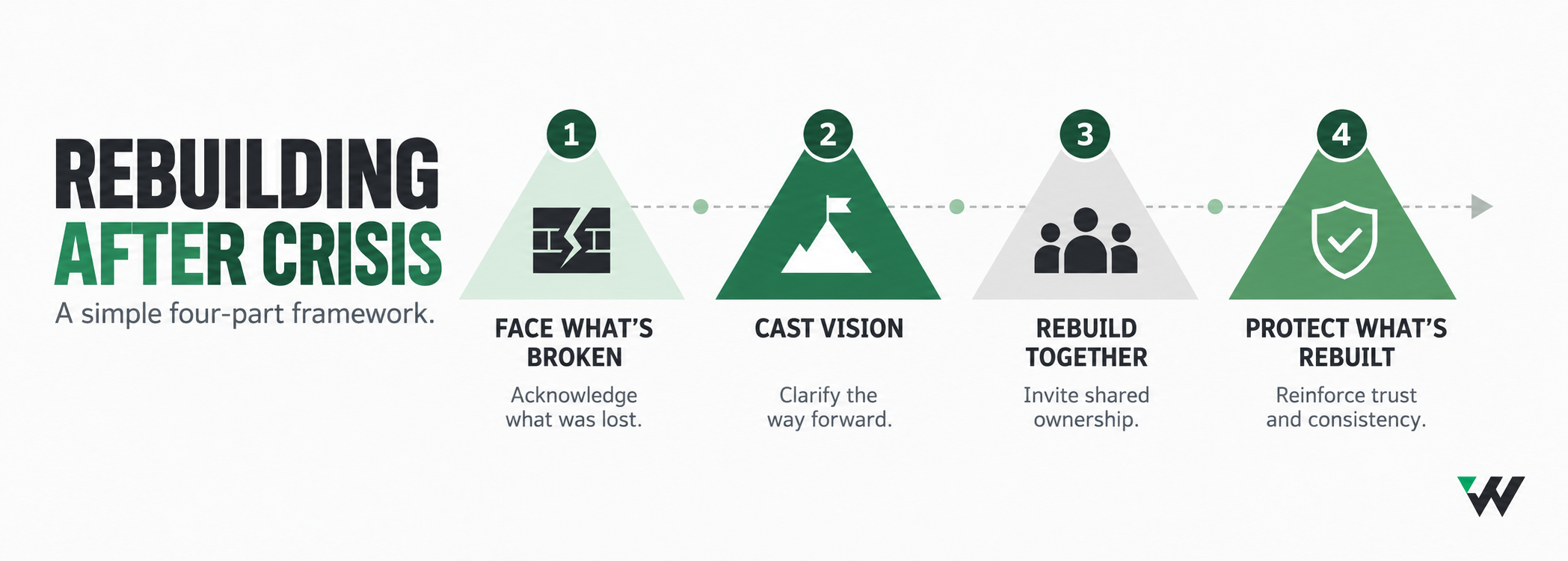
1. Face What's Broken Before Rebuilding Trust
When Nehemiah heard about Jerusalem, he didn’t ignore the difficult; he listened, grieved, prayed, and inspected the damage before proposing solutions (Nehemiah 1:1–11).
Many leaders are tempted to move too quickly after a difficult season, wanting to turn the page. Employees often need leaders to acknowledge what happened before asking them to move forward. They know when trust has been damaged, when communication has broken down, or when workloads have become unsustainable. Before rebuilding, leaders must honestly ask: What may this season have cost our people? What trust was lost? What frustrations remain unresolved? What are employees experiencing that leaders may not fully see?
You can only begin rebuilding after you understand what needs care and repair.
2. Cast a Credible Vision for Rebuilding
After assessing the damage, Nehemiah told the people, “Come, let us rebuild.” He acknowledged that rebuilding would not be easy. He acknowledged the reality and painted a picture of a better future. He provided hope, grounded in reality (Nehemiah 2:11–18).
A credible vision after seasons of change answers three questions:
- Why does rebuilding matter? Help employees reconnect to the mission and how the change supports the mission.
- What will improve? Paint a clear picture of what specific improvements employees should expect to experience
- How will we know we are making progress? Align on clear signs of shared progress towards the renewed vision.
People are more likely to move forward when they can see where the organization is going and how they can be a part of it. Healthy leaders make that path visible and, in the process, help restore hope.
3. Rebuild Workplace Trust Together
Nehemiah didn't rebuild the wall alone; he mobilized a community. Families, merchants, and leaders each took ownership of part of the work. The work became about shared ownership (Nehemiah 3: 1, 8, 28, 32).
Great cultures are rebuilt the same way. Many organizations mistakenly treat culture rebuilding as a leadership project. It's not. Leaders create the conditions, but people rebuild culture together. One of the most consistent findings in Best Christian Workplaces' data reveals that employees often want a greater voice in decisions that affect them.
| Question |
Senior Leaders |
Individual Contributors |
Difference |
| Employee involvement in decisions |
3.98 |
3.60 |
-0.38 |
*Five-point scale. Scores above 4.00 are considered healthy.
Leaders rate employee involvement in decisions at 3.98, while individual contributors rate it 3.60. Across roles, involvement in decision-making, acting on employee suggestions, and trust between leaders and staff rank among the lowest-scoring workplace experiences.
When people are excluded from rebuilding, trust can further erode. Instead, invite employees to help shape the response: improve communication with the teams experiencing the gaps, and redesign work with the people closest to it. People are more likely to support what they help create. Shared ownership helps restore trust.
Ask your teams:
-
- What should we stop doing?
- What should we continue doing?
- What would help us become a healthier organization?
4. Protect What You Rebuild
Nehemiah established systems to protect what had been rebuilt. In the same way, rebuilding culture after challenges requires the same discipline. Healthy cultures need consistent leadership behaviors, clear communication, accountability, and ongoing listening. These required practices reinforce trust over time and help renewed momentum last.
One Question for This Week
Ask three employees: “As we move forward, what is one thing we need to repair or do differently?” Then listen without defending. You may discover that the most important work ahead isn't creating something new, but restoring something valuable that was lost along the way.
Listening to a few trusted voices is a valuable place to begin. Listening systematically across your organization can give you a clearer picture of where trust is strong, where it needs rebuilding, and where your leadership attention is needed most.
That is exactly where Nehemiah began: by facing reality, casting a compelling vision, and inviting people to rebuild together. As Christian leaders, we can learn from Nehemiah’s example as we work to restore trust, strengthen unity, and build momentum in our own organizations.

 Faith Gaines


 Jay Bransford : October, 12 2026

 Giselle Jenkins