Is it time to release that individual from your staff? How do you know for sure? Should the ministry take on debt to further the Kingdom’s mission? What are God and your trusted advisors saying about these plans?
Leadership often requires decisions without full clarity or unanimous agreement. Astute leaders assess choices and their impact through prayer, listening, analysis, sound counsel, and alignment with core values. Yet many of the most significant leadership ideas and proposals still emerge without complete certainty or guaranteed outcomes.
The most seasoned leaders eventually face moments when they must move forward despite unanswered questions, competing opinions, and risk. This is where discernment becomes essential: the ability to lead wisely, humbly, and courageously without requiring total certitude.
A Biblical Foundation to Discernment
In the story of Jonathan and his armor-bearer, we find an example of relying on discernment rather than self-confidence or a proven solution. Jonathan decided to scout the enemy Philistines on his own, without alerting his father, King Saul, and his warriors.
“Jonathan said to his young armor-bearer, ‘Come, let’s go over to the outpost of those uncircumcised men. Perhaps the Lord will act in our behalf. Nothing can hinder the Lord from saving, whether by many or by few.’ ‘Do all that you have in mind,’ his armor-bearer said. ‘Go ahead; I am with you heart and soul’” (1 Samuel 14:6-7).
Jonathan and his armor-bearer faced overwhelming odds against the Philistines. Jonathan did not claim surety about what God would do. Instead, he stated, “Perhaps the Lord will act on our behalf.”
This biblical story illustrates that discernment is not an assurance of the end result, but rather a trust in God while stepping forward without knowing the outcome.
As leaders, we often launch initiatives, restructure teams, or make difficult decisions without a guarantee of success. “Perhaps” is not a popular response in our results-driven world. Yet Jonathan’s words remind us that discernment does not require certainty before obedience.
In Jonathan’s case, even without knowing whether victory was assured, his brave reliance on God’s power and provision led to the Philistine “army melting away in all directions” (1 Samuel 14:16). Even facing the possibility of death, his armor-bearer placed confident trust in Jonathan’s resolve. You can also seek guidance from the Lord and rely on faith-based discernment to overcome obstacles in your reasoned decision-making. You can also model the response of Jonathan’s right-hand man and preserve team unity by trusting and following the lead of those in authority over you.
Where Discernment Can Matter Most
Any directive you make may fall short of perfection, so it’s encouraging to know that you can rely on the Holy Spirit and on Jesus, your Wonderful Counselor (Isaiah 9:6), as you weigh the pros and cons. The following are areas where discernment proves particularly invaluable.
Understanding the Best Idea Is Not Always the Right Idea
Leadership is more complicated than simply choosing the strongest idea on paper. An initiative may be strategically sound yet still be the wrong fit for the season because of timing, change fatigue, misalignment, or limited capacity.
For example, with change fatigue, there may already have been too much change among team members, leaving relational capital low. In this case, it might be best to delay a decision or hold off on advancing an initiative. Sometimes, based on timing, the best idea is not the best fit for the team's makeup or key stakeholders.
Discernment helps leaders determine not only what could work but also what is right for a particular moment. We see this in 1 Chronicles 22, where David desired to build the temple for God, yet the assignment and timing ultimately belonged to Solomon.
Identifying Deeper Issues During Team Conflict
Conflict within teams often involves competing narratives, emotions, misunderstandings, and partial truths. Mature leaders must look beyond surface-level tension to identify the deeper issue driving the disagreement. Discernment enables leaders to respond thoughtfully rather than emotionally or reactively. In 1 Kings 3, when two women claimed the same baby, King Solomon’s discerning wisdom revealed the heart of the conflict.
Prioritizing the Right Initiatives
Leaders naturally have personal passions, preferences, and “pet projects” that can influence decision-making. Organizations also face endless opportunities, demands, and competing priorities. Discernment helps leaders sift through good ideas to identify what is most important for the mission, culture, and current timeframe. Without discernment, organizations can become distracted, fragmented, and exhausted. We see this in Acts 6, where the apostles delegated responsibilities to protect their focus on prayer and ministry priorities.
Discernment Involves Risk
In 1983, Apple co-founder Steve Jobs recruited PepsiCo executive John Sculley as Apple’s CEO to help boost Macintosh sales to big businesses. Jobs was head of the Macintosh division, but the two high-powered leaders eventually clashed. Jobs was seen as somewhat chaotic, and Macintosh sales were struggling. Sculley, with his reputable corporate experience, won over the board to keep him, while Jobs was essentially demoted from his own company to a symbolic position as chairman of the board.
In May 1985, Jobs was stripped of his management authority. By September, he resigned, taking five senior Apple employees with him to start an upscale computer company, NeXT. He also bought a small graphics studio that grew into Pixar.
Instead of wallowing in his career upheaval, Jobs relied on his discerning instincts to keep moving forward. A dozen years later, Apple bought NeXT for about $400 million and brought Jobs back as CEO.
Jobs famously credits being fired from Apple as one of the best things that happened to him. The business move taught him humility and gave him the executive experience he needed. The iconic Apple genius soon orchestrated one of the most notable corporate turnarounds in history.
Years later, Jobs drew on that hard-earned wisdom to make difficult decisions that helped transform Apple into one of the world’s most influential companies.
Jobs surrounded himself with other trustworthy innovators willing to take risks, even when the payoffs were uncertain. Discernment often separates the safe, easy path from the more grueling road less traveled.
How to Grow in Discernment
As you know, not every resolution is clear-cut, and you may need to go against the prevailing perspective. Sometimes discernment is needed to stay the course, and sometimes it’s needed to step into uncharted waters. Let’s consider three strategies for cultivating keen discernment in any decision-making process.
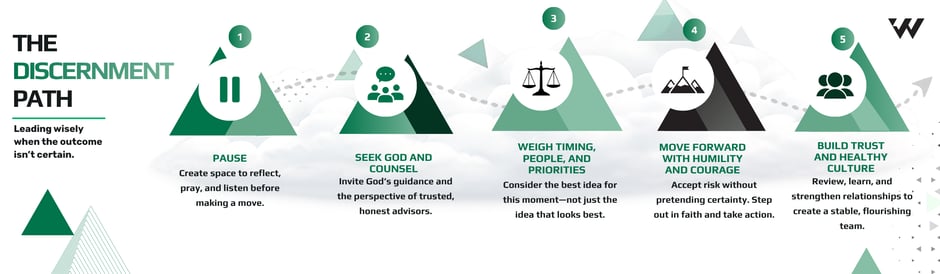
1. Create Space Before Major Decisions
Discernment weakens when leaders operate in constant reactive mode. Healthy leaders intentionally slow down before major decisions to pray, reflect, process emotions, and assess the situation carefully. Many poor choices stem not from a lack of intelligence but from a lack of pause and perspective.
2. Invite Honest Voices, Not Just Agreeable Ones
Discernment grows through informed, honest counsel. Strong leaders surround themselves with trusted people willing to challenge assumptions, expose blind spots, and speak the truth with wisdom. Leaders who isolate themselves or seek only affirmation often weaken their ability to discern clearly.
3. Reflect on Past Decisions and Patterns
Discernment develops over time through experience, humility, and reflection. Mature leaders evaluate both successes and failures to better recognize patterns in timing, people, culture, and leadership dynamics. Over time, discernment becomes the ability to recognize what is happening beneath the surface and to lead perceptively even without guarantees.
Discernment Builds Trust and Healthy Culture
Teams trust leaders who are thoughtful, steady, and humble under pressure. Where might God be inviting you to lead with wisdom, even when the outcome is unclear? Discernment reduces reactive leadership and creates stability amid uncertainty. Being honest and not overconfident about potential outcomes builds trust, as Jonathon did.
Healthy cultures are sustained by leaders who can navigate tension without needing absolute answers upfront. Mature leaders rely on discernment rather than surefire results—learning to hold tension, listen carefully, and move forward with humility and courage. In a world that rewards confidence, discernment is a deeper strength that shapes consistent, sound decisions and readies an engaged, flourishing workplace for any season, challenge, and opportunity.

 Robert Wachter



-%20Dana%20Costar.png?width=30&name=Staff%20Photo%20-%20Website%20(7)-%20Dana%20Costar.png) Dana Costar : April, 13 2026
Dana Costar : April, 13 2026

 Barry Slauenwhite