I once worked with a church that had a remarkably gifted worship leader and songwriter. Weekend worship was flourishing. New people were coming. Congregants loved the experience, and senior leaders were encouraged by what they saw from the platform.
But the staff experienced a different story on Monday morning.
The worship leader had become increasingly impatient during team discussions. Open dialogue was replaced by back-room conversations. Meetings grew tense, especially when someone offered feedback. Team members began measuring their words, protecting themselves, and quietly withdrawing. Each time someone raised a concern, leaders found another reason to excuse the behavior.
The worship leader’s talent was visible to everyone. The discouragement spreading through the staff was easier to overlook.
This is one of the most difficult dilemmas a leader will face: What do you do when someone is exceptionally capable, consistently delivers results, yet is slowly weakening the health of the team?
A High Performer Is More Than Results
Most organizations have people they consider indispensable. They may be a gifted youth minister, an IT expert, a teaching pastor, an operations director, a winsome fundraiser, or the longtime employee who holds years of organizational history in their head. Their knowledge is deep. Their contribution is significant. Replacing them would be difficult. This is precisely why leaders can become hesitant to address the way these high performers work.
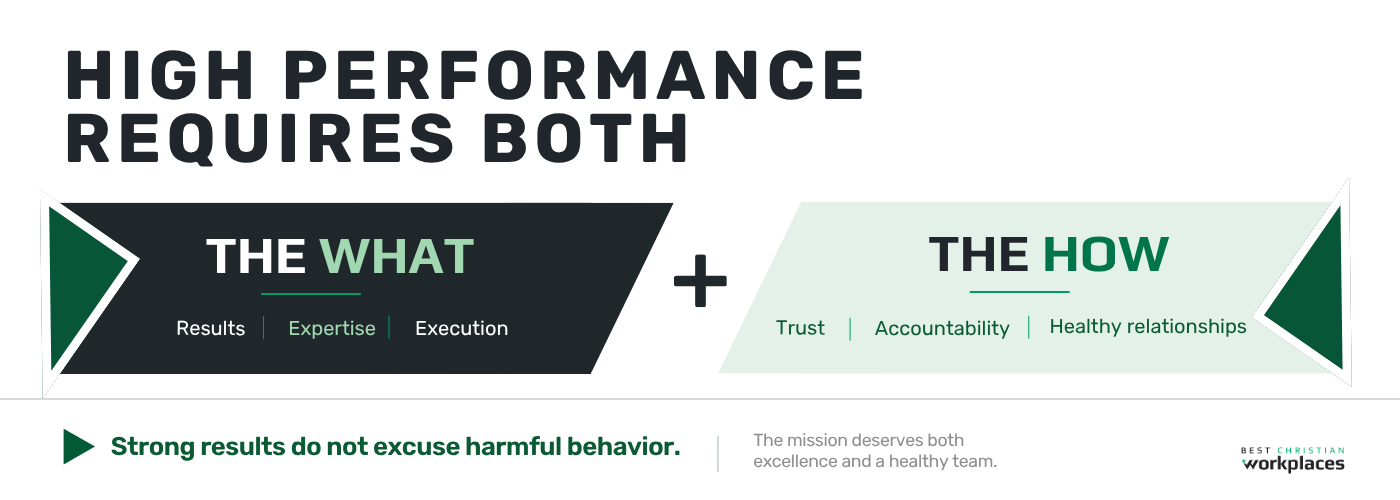
Healthy performance includes both “what” a person accomplishes and “how” the work gets done. A person may deliver outstanding results (the what) while dismissing colleagues, withholding information, resisting accountability, or violating the organization’s values (the how). When we evaluate only outcomes, we can mistakenly label someone a high performer while ignoring the cost others are paying for those results.
A strong performer who consistently delivers the “what” but damages the “how” is not fully high performing.
Toxicity is not simply a difficult personality. It is a repeated pattern of behavior that works against the values and health of the organization. Left unaddressed, that pattern begins to hold the culture hostage. Leaders stop speaking honestly. Teammates work around the person. Policies and values start to feel optional.
Eventually, the team receives a message—whether leaders intend it or not:
- Results matter more than relationships.
- Some people are allowed to operate by different rules.
- Speaking up is risky and probably will not change anything.
- Leadership will protect the high performer before protecting the health of the team.
That is when one person stops being merely difficult and starts becoming a culture buster rather than a culture builder.
But We’re Family
Christian leaders often struggle more with this issue because we genuinely care about people. We consider our coworkers brothers and sisters in Christ. We describe our teams as family. We want to extend grace, believe the best, and give people another chance. While these are good instincts, grace was never meant to become avoidance. One of my favorite workplace phrases is “In our culture we give everyone the benefit of the doubt. But, where there is no more doubt, there is no more benefit.”
I worked with another ministry where the longest-tenured executive knew nearly every detail of the organization’s facilities, finances, debt, giving history, and personnel costs. He was a good man who loved the ministry. He was also protective of information, made decisions without involving others, and gave orders instead of inviting feedback. Not even the CEO felt comfortable asking him questions.
No one wanted to confront him because everyone feared losing his knowledge and expertise. Eventually, he retired, but the culture ripple effects of fear and avoidance remained. Leaders had extended grace to one person while asking the rest of the team to absorb the consequences.
Colossians 3 calls God’s people to compassion, kindness, humility, gentleness, patience, and forgiveness. Those qualities should shape how we lead a difficult employee. They do not require us to ignore behavior that is hurting others. In a healthy Christian-led workplace, grace and accountability are not opposites. They belong together.
Protect the Whole Team
As you work through the situation, remain humble and curious. Ask what may be happening beneath the behavior. The employee may be carrying physical, emotional, spiritual, or family distress. Listen carefully. Offer appropriate care and support. Give the benefit of the doubt first.
But do not confuse understanding the behavior with excusing an ongoing pattern.
Healthy teams are built on more than individual talent. They are built when people can trust one another, contribute their best, receive honest feedback, and believe that the organization’s values apply to everyone. As Christian leaders, we are called to respond with clarity, grace, and accountability to every person God has placed in our care.
That means wanting the high performer to succeed. It also means refusing to sacrifice the health of the rest of the team to make that success possible.
Five Steps for Leading a Toxic High Performer
1. Move past fear
Fear is often the real reason leaders delay. We fear confrontation. We fear the person’s reaction. We fear disappointing a board, elders, congregants, or donors who see the public results but not the private impact. Most of all, we fear the person cannot be replaced.
When fear leads, avoidance can feel like wisdom. But delay rarely keeps the problem contained. It simply transfers the cost to everyone else.
Bring your fear honestly before God. Ask for wisdom, courage, and the right words. Then remember your responsibility: God has entrusted the entire team to your stewardship, not only its most visible or productive member.
2. Exercise your role as protector of the culture
Culture does not protect itself. Leaders protect it through clear expectations, consistent decisions, and the courage to address behavior that contradicts stated values.
This work should begin long before a serious problem emerges. Establish a consistent performance-coaching rhythm so every employee understands the outcomes expected of them, the competencies required for the role, and the behaviors that reflect your values. Talk about both the what and the how. When feedback is normal, correction is less likely to feel sudden or personal.
Employee-engagement feedback can also help leaders see what they may be missing. Diminishing trust, unfairness, poor communication, or lack of confidence in leadership may be early evidence that staff is experiencing inconsistency—even when senior leaders cannot yet see the source.
3. Use a confidential professional as a sounding board
Difficult performance issues should remain private, but private does not have to mean isolated. A trusted HR professional, coach, board member, or advisor can help you separate facts from frustration, identify the real issue, and prepare for the conversation.
Use that person as a sounding board—not as a substitute for speaking directly to the employee. Practice what you need to say. Ask: Is this specific? Is it fair? Can I describe what I have observed without attacking the person’s motives? Have I explained the impact on the team? Is the expectation for change clear?
Good counsel helps us enter the conversation prepared, calm, and accountable.
4. Remember that feedback is a form of kindness
Withholding the truth is not kindness. It allows someone to believe they are succeeding fully when an important part of their performance is falling short. Honest feedback gives the person an opportunity to see what others are experiencing and choose a different path.
A kind and candid conversation might sound like this:
“Your contribution is valuable, and I want you to expand your impact and influence here. I also need to address a pattern that is affecting the team. When [specific behavior] happens, the impact is [specific effect]. Going forward, I need to see [clear expectation]. Let’s talk about the support and accountability that will help you make that change.”
Notice that this conversation does not label the person as toxic, question their character, or recruit a group of coworkers to build a case. It names observable behavior, explains the impact, restates the expectation, and offers a path forward.

 Tara VanderSande



 Giselle Jenkins : October, 27 2025


 Tara VanderSande