As a leader, how do you obtain accurate and meaningful feedback from employees at all levels of your organization? And once you’ve taken action to incorporate feedback to improve workplace health, how often should you ask for additional feedback?
Building and sustaining a healthy workplace culture is a continuous process. Organizations that flourish in the long term have active feedback loops that provide strategic input for operational excellence.
Strategic listening includes both quantitative and qualitative feedback on a systematic, ongoing basis.
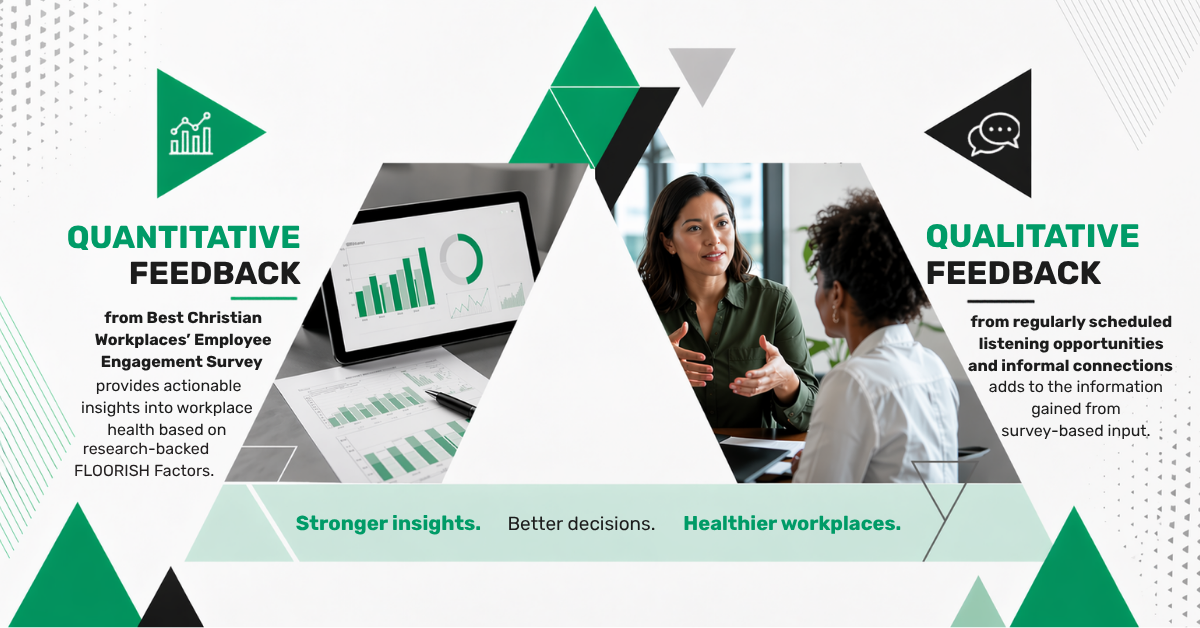
Organizations are dynamic entities, so feedback is not a one-and-done activity, but a continuous cycle of discovery, growth, and building. Flourishing organizations build active feedback loops into their regular cycles, so a culture of listening and improvement is integrated into their planning systems.
Is There an Ideal Cycle for Assessing Employee Engagement?
Just like an annual physical check-up can alert you to issues that might be lurking in your physical health, an annual cycle of measuring employee engagement provides essential input into ongoing improvement and organizational health.
There isn’t a single ideal time to gather input, but the emphasis should be on a regular schedule that fits within other organizational cycles. For example, a church might want to schedule its annual Employee Engagement Survey for January or February—away from special holiday services and fall ministry launches.
Many Ministry Partners find it useful to position their employee engagement input 2-3 months prior to budgeting, annual planning, or strategic planning cycles. This integrates action to improve workplace health into overall organizational priorities, rather than treating it as a separate activity. Effective leaders leverage feedback from survey results and related action plans into a cohesive strategy to achieve organizational goals.
A large multi-site church I work with has built annual employee engagement surveys into its process. The staff knows they will be asked to provide honest, anonymous feedback every year. This accountability serves as a release valve and demonstrates a trust relationship in the ministry. They have seen their employee engagement and health go up consistently for 10 years. In addition, they have layered in Leadership 360s every 2-3 years to support leadership development and the culture of feedback. Their cycles of active feedback and intentional action create a culture of highly engaged employees who find joy in their work.
Active Listening In Addition to Surveys
In addition to quantitative assessment, active listening through regular qualitative feedback from your staff demonstrates that your leadership team values the ideas and input of employees.
A segment of your employees might consistently offer unsolicited feedback, but the loudest voice doesn’t necessarily represent the overall sentiment among your employees.
Listening leaders take the initiative to seek out feedback from a broad spectrum of employees. You can invite people to “skip-level” sessions, where participants are not your direct reports, but employees at a different level. A few simple questions will invite honest feedback:
- What is one current blessing or positive experience in your department?
- What is one barrier to accomplishing your work that you would like to remove?
You can also make use of online tools to generate feedback. Use an idea-sharing thread on your Teams or Slack message board. Periodically, post specific questions about common issues to seek feedback. You can also schedule “make us better” challenges to elicit ideas to solve problems.
Discovery Groups with an experienced Best Christian Workplaces consultant can help you uncover hidden issues. They can identify blind spots that may not be visible to senior leaders. Used in conjunction with Employee Engagement Survey data, Discovery Groups offer a focused, deep dive into specific areas for growth.
With all of your listening activities, be sure to include a communication loop to share results with employees. They want to know how ideas are vetted and what happens to ideas that are not implemented.
When employees are consistently asked for quantitative and qualitative input, it builds trust in leadership, especially when feedback is welcomed, and there is no blowback for honest responses. Using active feedback loops to listen to quantitative and qualitative input on a systematic basis and acting on the information gained puts your organization on the road to flourishing for long-term health.
What About Transitional Seasons: Should We Pause Assessments?
Up-to-date employee engagement data is valuable at any time, including during a leadership transition. Sticking to your regular annual assessment cycle will signal to your employees that you still care about their feedback and trust their honesty. And a new leader stepping in can gain valuable insight from survey data.
One of our longtime Ministry Partners with a regional leadership structure regularly moves leaders around to different regions. They have found that doing annual survey assessments as part of their operational best practices helps them with leadership transitions. An ongoing investment in healthy workplace culture allows new leaders to step into processes that are already working.
Something is always changing in your organization. Transitions in top leadership might be the most obvious changes, but every new employee brings something new to your workplace culture. There are always internal and external factors changing your organization. Even very positive changes, such as fast growth, require adaptation throughout your organization. Continuing to assess workplace health on an annual cycle provides valuable information for leaders managing a dynamic environment. The reality of ongoing change is a compelling argument for consistent attention to employee engagement.
Why Keep Surveying If Our Scores Are Steady?
Employee Engagement Survey results are more than just one number. While there may not be much variation in the overall Employee Engagement Score, the Best Christian Workplaces process provides robust measures across eight FLOURISH Factors. Your detailed survey report highlights specific areas for improvement. Your Best Christian Workplaces consultant can help you focus on a few action items that offer the greatest leverage for improving engagement.
Detailed survey results mean you can identify trends at the department level. While the assessment should never be punitive, it can be instructive to notice specific teams that perform above or below average. A team that might be struggling can learn best practices from healthier teams.
In addition to diving deeper into your data, your ongoing commitment to improving workplace health signals to your employees that their experience matters. The discipline of humbly asking for input from your employees demonstrates how much you value their participation. And as with the analogy of a physical check-up, progress might take time, but it is always worth it to continue to focus on healthy, life-giving practices.
If your organization has never participated in a research-based Employee Engagement Survey, reach out today to find out more about what Best Christian Workplaces can offer your leadership team.
And if your survey results are more than a year old, now is the best time to get back on an annual cycle for continuous improvement.
Resources:

 Tara VanderSande



 Dr. Doug Waldo : April, 28 2025

 Giselle Jenkins