"We need to begin living the values we have written down." It's a telling statement, and unfortunately all too common among leaders in Christian ministry. As fallen people, we all need reminders of the strongly-held shared beliefs that guide our behavior in the workplace.
Values: Strongly-held beliefs evidenced by outward behaviors throughout an organization that help form its culture.
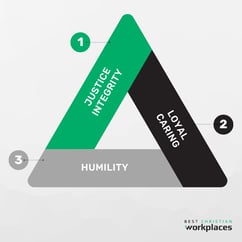 Creating organizational values is a key step in building a healthy culture. But is there a Biblical basis for building virtue-based values statements? Dr. Richard Biery, president of The BroadBaker Group, presents a Biblical concept from Micah 6:8 that guides us in establishing meaningful values in a workplace, Christian or not.
Richard tells us to look at Micah 6:8 not as a list, but as a more complex integrated system. By understanding how the three characteristics mentioned in Micah 6:8 relate to each other, a very clear picture begins to emerge. But first, let’s look at what the verse actually says:
“God has showed you, O man, what is good. And what does the LORD require of you? To act justly and to love mercy and to walk humbly with your God.” Micah 6:8 (NIV)
Each key requirement has a unique meaning for us to examine as we explore a model to evaluate our personal and organizational value system.
- Act Justly: Looking at what justice is in a cultural setting, it translates into “doing what is right” and personal integrity. To act justly in today’s world would include speaking and acting honestly, seeking the truth, pursuing excellence (which is integrity in action), and being diligent in acting fairly.
- Love Mercy: Mercy is translated from the Hebrew word, chesed – a complex word, but in summary it means "loving kindness." Old Testament scholar N.H. Snaith suggests that "the word is used only in cases where there is some recognized tie between the parties concerned." God established a covenant with Israel, so his chesed for Israel occurs within the context of a formal relationship. However, the word also takes on one more meaning: "The continual waywardness of Israel has made it inevitable that, if God is never going to let Israel go, then his relation to his people must in the main be one of loving-kindness, mercy, and goodness, all of it entirely undeserved. For this reason, the predominant use of the word comes to include mercy and forgiveness as a main constituent in God’s determined faithfulness." So, NIV scholars translate chesed as mercy because that’s what God continually showed to Israel. Another way to consider the meaning is the use of the term "committed love." This committed love in the workplace looks like being thoughtful, treating others with courtesy, respect, and kindness.
- Walk Humbly With God: Having humility in the workplace requires putting other people first, listening, asking for and giving forgiveness, having an attitude of gratefulness, and being teachable (open to learning).
When we plot these three traits as points on a triangle, we can see how they interact. Each interaction point is a key aspect of Christian culture in an organization. If one of these aspects were missing, then the culture could turn toxic. Let’s look at these aspects and examine how they fit into the workplace.
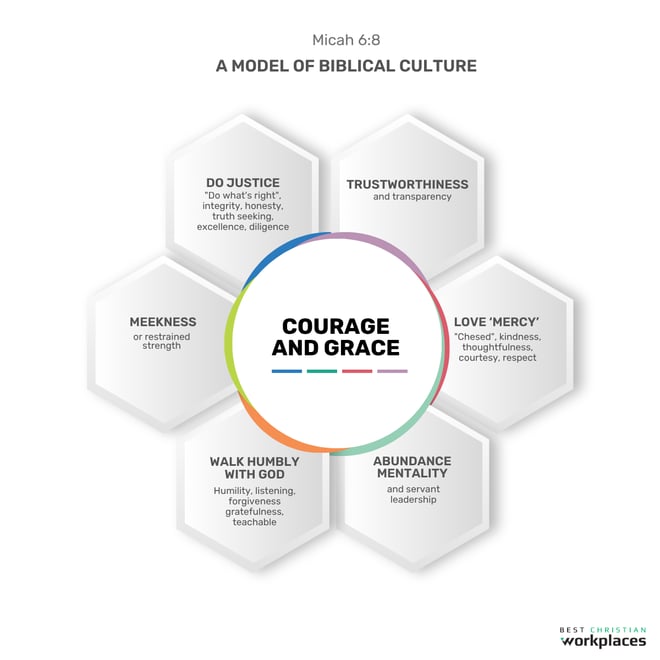
Justice + Mercy= Trustworthiness
The combination of integrity from doing justice and the committed love of mercy is trustworthiness and transparency. You need both integrity and love for trustworthiness to work.
An example of what integrity without committed love looks like is the IRS. When an IRS agent comes to examine your finances, you know he’s going to do an accurate, thorough, and honest job. But he’s not on your side; there is no mercy or kindness coming from him. You don’t trust him despite having integrity because committed love isn’t there to inspire trust.
On the other hand, committed love without integrity is also untrustworthy. Even if you know that a coworker is going to treat you with kindness and respect, but you don’t trust them to do the right thing, or be honest, or do their work with excellence, then you don’t trust them either.
Leadership Visibility and Trust
Similar to the IRS agent example, a leader of an organization who is holed up in their office or absent due to travel has difficulty building trust with their staff. As we explore the reasons behind low levels of trust between senior leaders and staff in Christian-led organizations, we find visibility to be an important criterion. A personal connection is required for an individual to feel kindness or respect from a leader. In fact, we have often heard from staff who feel disrespected because their leader is absent from the workplace for prolonged periods. They feel the leader has no interest in them as individuals.
To build trust and transparency through relationships, leaders have employed a tactic known in many circles as “Managing by Wandering Around” (MBWA). The following are a few tips to guide leaders who are interested in building trust.
- Appear relaxed as you make your rounds. Employees will reflect your feelings and actions.
- Remain open and responsive to questions and concerns.
- Observe and listen, and let everyone see you do it.
- Make certain your visits are spontaneous and unplanned.
- Talk with employees about their passions – whether family, hobbies, vacations, or sports.
- Ask for suggestions to improve operations, service, ministry, etc.
- Try to spend an equal amount of time in all areas of the organization.
- Catch your employees doing something right and recognize them publicly.
- Convey the image of a coach – not an inspector.
- Encourage your employees to show you how the real work of the organization gets done.
MBWA works best when you are genuinely interested in employees and their work, and when they see you as someone who is there to listen. It sometimes requires follow-up. When you can't answer an employee's questions on the spot, get back to them with an answer within 48 hours.
So, in the workplace, we need to act with both integrity and committed love. In doing so, we will become trustworthy and invest our trust in our coworkers, leading to a healthier, more effective workplace. Trust helps decisions be made and executed faster, saving time, money, and the emotional energy it takes to bring suspicious people onto your side. Trustworthiness also enables people to give wise and constructive feedback, helping you to pursue excellence in your work and correct mistakes.
Mercy + Humility= Servant Leadership
The combination of committed love and humility is an abundance mentality and servant leadership. This attitude can be described as "generous thinking": Not just getting a bigger piece of the pie, but making the pie bigger so everyone can have more.
Having committed love with humility brings sincere care for both your work and the people you work with. It also enables servant leadership, putting others before yourself with that committed love. Part of this servant leadership is openness and transparency, made possible by humility. Once one’s ego is out of the way, then people can work together and be open about ideas, feedback, and progress.
Southland Christian Church models servant leadership through MBWA, not only to engage with employees but also to ask what managers can do for them. Their leadership is constantly asking the questions: “How are you doing?” and “What can I do to help?” This demonstrates genuine chesed for employees and shows that the SCC leadership team wants their managers to show concern for those who work under them.
Humility + Justice = Meekness
The final combination of humility and integrity is meekness. The term meek has taken on a new meaning in the evolution of the English language, so looking back to the Greek will help understand what this idea means. The Greek word translated as meekness is proutes. They used this word to describe incredibly powerful and highly trained warhorses riding into battle. They were extremely strong, but disciplined, self-restrained, and completely submissive to their riders. The old English use of the term also conveys this idea: incredible strength restrained to the point of gentleness.
We look for meekness in our Superheroes: strength that follows a higher ideal or power, and is a team player. This idea is really important for senior leadership because it serves as a guard against arrogance. Arrogance leads to entitlement, and entitlement leads to embezzlement and greed. Having good leaders who are humble and have integrity is a surefire way to hedge against corporate scandal.
Another aspect of meekness is teachability. Someone who is humble and seeks the truth will always be open to learning from others. This curiosity will lead to new innovations and promote an innovative attitude in other employees.
The Heart of the System is Courage and Grace
This system of integrity, committed love, and humility – which leads to trustworthiness, servant leadership, and meekness – is crucial in the workplace to bring out employees' full potential. Having a Micah 6:8 mentality will create a workplace that respects each employee, builds trust, loves, encourages, and unleashes each person's creative talent and productivity to further God’s kingdom.
However, this does not mean that it will be easy, or that your workplace will be a "pie in the sky" utopia with no conflict and everyone in perfect harmony. Acting with integrity is hard work. Loving people is hard work. Being humble is hard work.
Acting with integrity is hard work. Loving people is hard work. Being humble is hard work.
There will be conflict, hurt relationships, and tumbling off the straight and narrow. That’s why, at the heart of this system, is the courage God instills in us to do this work, and the grace for us and for each other to make mistakes. Hopefully, you find this as helpful as we have in creating a Christ-centered culture in the workplace.
Learn More About Organizational Values
- Dig deeper into this concept by The BroadBarker Group.

 Al Lopus



-%20Dana%20Costar.png?width=30&name=Staff%20Photo%20-%20Website%20(7)-%20Dana%20Costar.png) Dana Costar : April, 13 2026
Dana Costar : April, 13 2026

 Tara VanderSande
 Giselle Jenkins